
How to Choose Therapy Practice Software in India
A practical framework for choosing practice management software as a therapist in India: security, DPDP compliance, data residency, clinical fit, and the questions to ask before you commit.
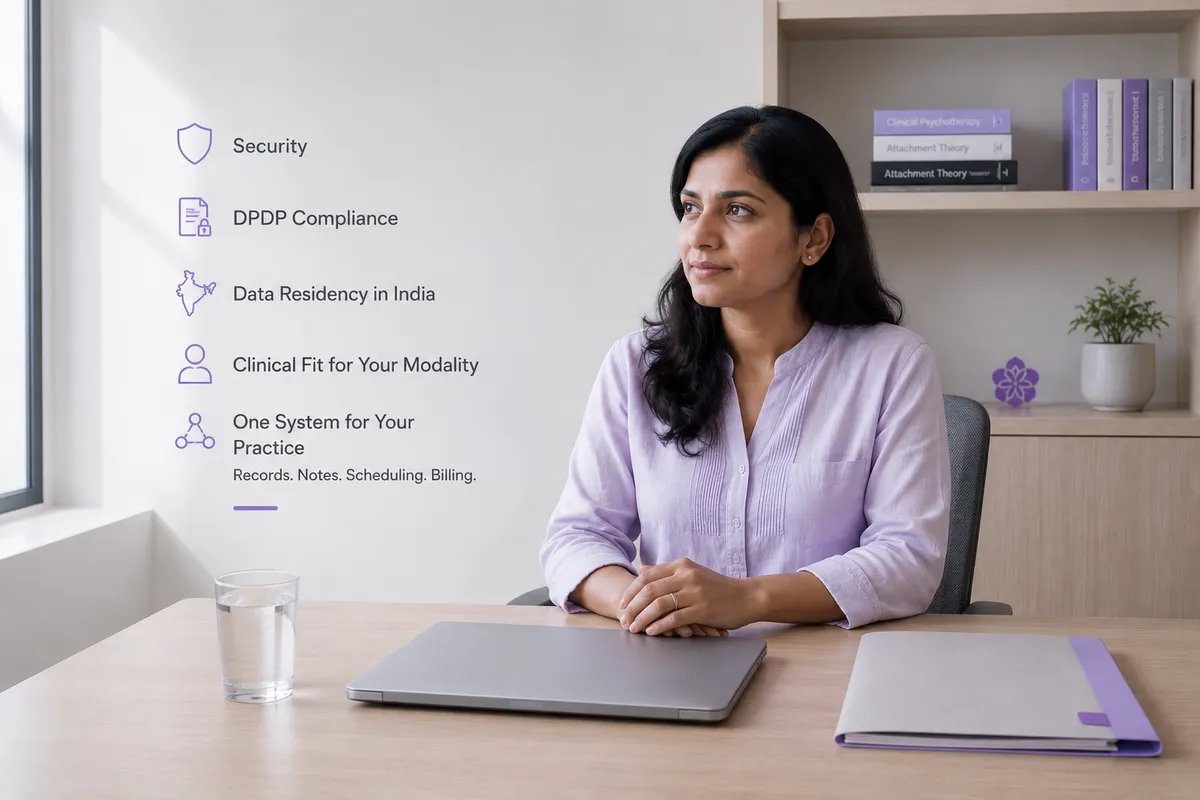
The criteria that matter, the India-specific requirements most tools miss, and the questions to ask before you trust a platform with your practice.
Summary
Choosing practice management software as a therapist in India means evaluating five things: security, compliance with the Digital Personal Data Protection Act, data residency in India, clinical fit for the modality you practise, and how well one system holds your records, notes, scheduling, and billing together. Most tools available to Indian practitioners handle one or two of these well and leave the rest to the practitioner. This article gives therapists, psychologists, and psychiatrists a clear framework for the decision: how to map your practice’s real needs, why security and DPDP readiness are non-negotiable, what India-specific requirements a tool has to meet, and how to judge clinical fit. It closes with the exact questions to ask any platform before committing. The guidance is written for solo practitioners and clinic-based teams making a decision that will shape how their practice runs for years.
Table of Contents
- How to Choose Practice Management Software as a Therapist in India
- Start With What Your Practice Actually Does
- Security and Compliance Come First
- The India-Specific Requirements
- Clinical Fit: Documentation and Modality
- Why One System Beats a Stack of Tools
- The Questions to Ask Before You Commit
Choosing practice management software as a therapist in India comes down to five questions. Is client data secure. Is the platform ready for the Digital Personal Data Protection Act. Are records stored in India. Does the documentation fit the way you actually practise. And does one system hold your records, notes, scheduling, and billing together, or will you stitch that together yourself. A tool that answers all five was built for a practice like yours.
Most practitioners choose software the way they choose most tools: they pick what a colleague uses, or what turns up first in a search, and adapt around it. That works until the practice grows, or a client asks where their data is stored, or the DPDP compliance deadline arrives and the tool was never built for it.
This post gives you a framework for the decision instead. It covers what to evaluate, the India-specific requirements a tool has to meet, and the questions that separate software built for Indian mental health practice from software that is simply available here.
How to Choose Practice Management Software as a Therapist in India
The decision is easier when you evaluate against a fixed set of criteria rather than feature lists. Five criteria matter, in this order.
Security: client records are encrypted, access is controlled, and the platform is built to protect sensitive clinical data.
Compliance: the platform is ready for the DPDP Act and supports your obligations as the practitioner who holds client data.
Data residency: records are stored on servers in India, under Indian law.
Clinical fit: the documentation, modality support, and telehealth match the kind of mental health work you do.
Integration: one system holds records, notes, scheduling, and billing, so the practice runs from a single place.
Security and compliance come first because they are the criteria a practitioner cannot fix later. A tool with a beautiful calendar and no encryption is a liability. The sections below take each criterion in turn.
Start With What Your Practice Actually Does
Before evaluating any tool, map what your practice does in a week. The right software is the one that fits your actual workflow, not the one with the longest feature list.
Write down the real operations: how clients find and book you, how you take notes, where those notes live, how you run online sessions, how you invoice and record payments, and how you keep track of a client’s history over months of care. A solo counsellor seeing eight clients a week has a different map from a psychiatrist running structured evaluations and medication reviews, and both differ from a clinic coordinating several practitioners.
That map is your specification. It tells you which criteria carry the most weight for you and which features are noise. A tool that does ten things you will never use, and does the three things you do every day poorly, is the wrong tool no matter how good the demo looks.
Mapping the workflow first also prevents the most common selection mistake: choosing software for the practice you have today and outgrowing it in a year. If there is any chance you will add a practitioner, move sessions online, or grow into a clinic, the right choice is a system that scales with you without a painful migration later.
Security and Compliance Come First
Client records in a mental health practice are among the most sensitive data a person ever generates. A breach of diagnoses, session notes, or medication history carries consequences for a client that reach into employment, relationships, and their willingness to seek help again. Security is not a feature to compare late in the process. It is the first gate any tool has to pass.
Secure software encrypts client data so it stays unreadable to anyone without the keys, wherever it is stored or sent. It restricts access by role and by client, so not everyone in a practice can open every record, and it logs who accessed what. And it is built to a known clinical security bar rather than assembled from general productivity tools that place the full compliance burden on you.
Compliance sits directly on top of security. India’s DPDP Act is now enforceable law, with substantive obligations enforceable from May 13, 2027. As the practitioner holding client data, you are the Data Fiduciary, and the Act gives you specific obligations: proper consent before collection, security safeguards for sensitive data, a way for clients to access and correct and delete their records, and breach notification within set timelines. A platform that is DPDP ready supports those obligations by design. A platform that treats compliance as a word on a webpage leaves you to retrofit it yourself.
For the full breakdown of what secure mental health software requires, see our guide on what makes mental health software secure. For the practitioner’s obligations under the Act, see our guide on what DPDP means for mental health practitioners in India.
The India-Specific Requirements
A tool can be secure and well built and still be the wrong choice for an Indian practice, because it was designed for another market’s rules and rhythms. Four India-specific requirements separate software built for this country from software merely available here.
Data residency in India: records stored on Indian servers sit under Indian law and remove the cross-border transfer questions that arise when data lives abroad. The question to ask is plain: where, physically, is my client data stored?
DPDP alignment: the Act is India’s own data protection law, and readiness for it is not the same as readiness for a foreign standard. A tool built for India supports DPDP consent and data-handling obligations directly.
Language and communication: India recognises 22 Eighth Schedule languages, and a practice serves clients across several. Consent notices and client communication have to work in the languages you actually use.
Billing and record-keeping that fit Indian practice: invoicing, payment records, and the daily admin of a practice should reflect how practices run here rather than adding friction from assumptions made for another market.
A tool that meets the security bar but stores data abroad, or handles compliance for another country’s law, is solving a different problem from the one an Indian practitioner has. For a fuller treatment of what to look for, see our guide on mental health software built for India.
Clinical Fit: Documentation and Modality
Practice management software is only as useful as its fit with the clinical work. This is where general tools and generic platforms fall short, because they flatten every practitioner into one note format and one workflow.
Documentation is the clearest test. A psychiatrist recording a mental status examination, a diagnosis, and a medication history needs structure that a single free-text box cannot hold. A clinical psychologist running assessments needs different templates again. A counsellor writing process notes needs something else. Software that fits clinical practice supports documentation shaped to the modality, not one generic template stretched across all of them.
Continuity is the second test. Mental health care runs over months and years. The software has to hold a client’s longitudinal history in a form the practitioner can rely on across every session, so that a psychiatrist reviewing a medication change or a therapist returning to a client after a gap has the full record in one place.
Aroha is built for this range. Its documentation is modality-aware, its psychiatric evaluation templates and longitudinal case histories are designed for the depth psychiatry requires, and its draft-to-final discipline keeps records clean and dependable. Software that treats psychiatry, psychology, and counselling as distinct clinical work, rather than one undifferentiated category, is the software that fits real practice.
Why One System Beats a Stack of Tools
Many practitioners end up running their practice across a handful of disconnected tools: a calendar app for booking, a notes app for documentation, a messaging app for reminders, a separate video tool for online sessions, a spreadsheet for payments. Each was adopted because it was convenient at the time. Together they create a fragmented practice.
Fragmentation carries real costs. Client information scatters across accounts that were never built to hold clinical data, which is both a security risk and a compliance gap. Time drains into moving between tools and reconciling what each one knows. And nothing holds the full picture of a client, because the picture is split across five places.
One system built for the whole practice closes those gaps. Records, notes, scheduling, telehealth, and billing sit together, under one set of security and access controls, with one place to look for a client’s history. The practice runs from a single foundation instead of a patchwork.
Aroha unifies client records, notes, and appointments in one system, hosted on India-based servers with encryption and role-based access throughout, and it scales from a solo practice to a multi-practitioner clinic without replatforming or migrating data. Choosing one system built for the work is choosing not to rebuild your practice’s infrastructure every time it grows. For a closer look at the fragmentation problem, see our guide on how to manage therapy clients without losing track.
The Questions to Ask Before You Commit
Before you move a practice onto any platform, put it through these questions. A tool built for Indian mental health practice answers all of them clearly.
Where, physically, are client records stored? For Indian practice, the answer should be India.
Is client data encrypted so it stays unreadable without the keys? Records should be protected wherever they are stored or sent.
Is the platform DPDP ready? It should support consent capture, client access and deletion requests, and breach notification.
Can access be restricted by role and by client, and is it logged? Not everyone should see every record.
Does the documentation fit the modality you practise? Psychiatry, psychology, and counselling have different needs.
Does it keep a usable longitudinal history? Care runs for years, and the record has to hold across that span.
Does one system hold records, notes, scheduling, and billing, or will you stitch tools together?
Does it scale as the practice grows, without a painful migration later?
If a platform cannot answer these plainly, that is your answer. A tool that hedges on where data lives, or leaves compliance to you, or fits only the practice you have today, is not the one to build years of client care on.
Aroha is built to answer all eight. Client records are hosted in India, kept encrypted and private, and protected by role-based access, with modality-aware documentation, integrated scheduling and telehealth, and a system that grows from solo practice to clinic without replatforming.
The software a practice runs on shapes how that practice works every day for years. Aroha publishes practical guides like this one for mental health practitioners in India, written for the decisions practitioners here actually face. Follow the blog for the rest of the series.
The information in this post is provided for general awareness and is not legal advice. For guidance specific to your practice’s obligations, consult a qualified legal professional.
Related Articles
What to Look for in Mental Health Software Built for India
Mental health software built for India keeps client data on Indian servers, is DPDP-ready, and fits how care is practised here. What to look for, and how to tell.
How to Keep Client Data Safe as a Therapist in India
A practical guide to protecting client data in a therapy practice - the real risks, encryption, access control, secure storage, and what DPDP compliance requires day to day.
What Makes Mental Health Software Secure?
A practitioner's guide to what makes mental health software secure; encryption, HIPAA alignment, DPDP readiness, access control, and data residency. The criteria to verify before trusting any tool with client data.