
What to Look for in Mental Health Software Built for India
Mental health software built for India keeps client data on Indian servers, is DPDP-ready, and fits how care is practised here. What to look for, and how to tell.
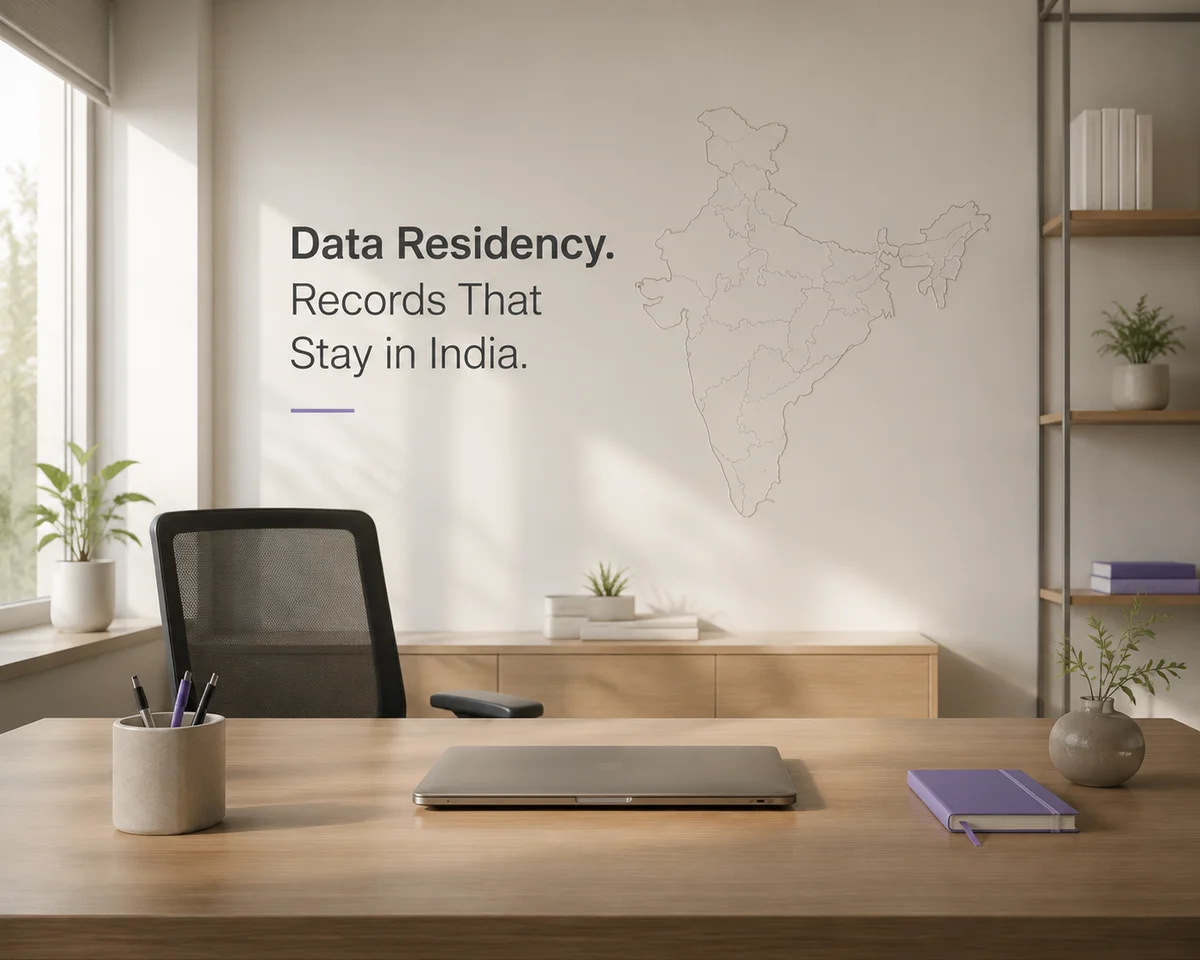
The standard that separates software designed for Indian practice from tools that happen to be available here.
Summary
Mental health software built for India stores client data on servers physically located in India, is ready for the Digital Personal Data Protection Act, and is designed around how care is actually delivered here, across languages, modalities, and the regulations that govern clinical records and telepsychiatry. This article defines that standard for therapists, psychologists, and psychiatrists in India. It explains why data residency in India is the most defensible position, what DPDP readiness requires of any tool handling Indian client data, and what the clinical context of Indian mental health care demands from software, from language and modality to the regulations that govern telepsychiatry. It closes with a checklist a practitioner can use to tell whether a tool was built for India or simply made available here. The guidance is written for solo practitioners, clinical psychologists, psychiatrists, and clinic-based teams working in the Indian context.
Table of Contents
- What “Built for India” Actually Means
- Data Residency: Records That Stay in India
- DPDP Readiness by Design
- The Clinical Realities of Indian Practice
- Telehealth That Meets Indian Regulation
- How to Tell If a Tool Was Built for India
Mental health software built for India stores client records on servers physically located in India, is ready for the Digital Personal Data Protection Act, and is designed around how mental health care is practised in this country. Those three things are the standard. A tool that meets them was built for Indian practice. A tool that meets only some of them was built somewhere else and made available here.
The distinction matters more in mental health than almost anywhere else. The data a practitioner collects, diagnoses, session notes, medication histories, intake records, is classified as sensitive personal data under Indian law, and it sits at the centre of a regulatory framework that is specific to this country.
This post defines what “built for India” means in practice, section by section, and gives you a way to check any platform against it before you trust it with a single client record.
What “Built for India” Actually Means
“Built for India” is a claim any tool can print on a webpage. The standard behind it has four parts, and a platform built for Indian mental health practice holds all four.
-
Data residency in India places client records on servers inside the country, under Indian law and Indian accountability.
-
DPDP readiness means the platform supports the obligations the Digital Personal Data Protection Act places on a practitioner, from consent capture to breach notification.
-
Clinical design for the Indian context means the documentation, the modality support, and the telehealth are shaped by the regulations and realities of mental health care in India, including psychiatry.
A tool can be excellent at one of these and absent on the others. Global platforms often have sophisticated engineering and store data in another country entirely. Generic productivity tools handle notes and calendars and know nothing about DPDP or clinical documentation. Built for India is all three, working together, for the practice you actually run.
Data Residency: Records That Stay in India
Data residency is the physical and legal location of your client records. It decides which country’s laws govern the data and which authority is accountable for it.
For an Indian mental health practitioner, data residency in India is the most defensible position. It places client records under Indian data protection law. It removes the cross-border transfer questions that arise the moment data sits on a server in another country. And it matches what a client in India reasonably expects when they share something sensitive with a practitioner in India.
Many global tools store data wherever their infrastructure happens to sit, often outside India, and the practitioner is rarely told where. Under the DPDP framework, that uncertainty is a compliance gap. The question to ask any platform is plain: where, physically, are my client records stored? A platform built for India answers India, specifically and without hedging.
This is the first line to check, because everything else, consent, security, breach response, sits on top of where the data lives. Records held in India, under Indian law, are the foundation the rest of the standard is built on. For the full picture of why storage location is a security decision and not a convenience one, see our guide on how to keep client data safe as a therapist in India.
DPDP Readiness by Design
India’s Digital Personal Data Protection Act is now enforceable law. The DPDP Rules were notified on November 13, 2025. The provisions governing consent managers take effect on November 13, 2026, and the substantive compliance obligations become enforceable on May 13, 2027. Any tool that handles the personal data of Indian clients falls under the Act, and so does the practitioner using it.
A DPDP-ready platform supports the obligations the Act places on you as the Data Fiduciary. It gives you the means to obtain and record proper consent before any data is collected. It applies security safeguards appropriate to sensitive clinical data, including encryption and access controls. It supports your ability to respond when a client asks to access, correct, or delete their records. And it provides a path for breach notification within the timelines the Act sets.
DPDP readiness is structural, not a label. The consent flows, the security controls, and the data-handling processes either support your obligations or they do not. A platform built with the Act in mind makes compliance the default, so you are not retrofitting consent notices and data controls into a practice already in motion. For a full treatment of what the Act requires of mental health practitioners specifically, including consent, data residency, and your six core obligations as a Data Fiduciary, see our guide on what DPDP means for mental health practitioners in India.
The Clinical Realities of Indian Practice
India carries one of the highest mental health treatment gaps in the world. The National Mental Health Survey of India, 2015-16, found that close to 83 percent of people with a mental disorder received no treatment, and that roughly one in seven adults needed care for one or more conditions. Practitioners here work against that backdrop: high demand, long caseloads, and clients who often arrive after a long delay in seeking help.
Software built for India accounts for this reality in concrete ways.
-
Language: India recognises 22 Eighth Schedule languages, and clients do not all speak the same one. Consent notices and client-facing communication have to work across the languages a practice actually serves.
-
Modality: a psychiatrist documenting a mental status examination and a medication history has different needs from a counsellor writing process notes. Software built for the Indian clinical landscape supports documentation that fits the modality rather than flattening every practitioner into one generic note format.
-
Psychiatry as its own domain: psychiatric practice requires structured evaluations, longitudinal case histories, and medication tracking that carry across every session in a client’s care. A tool built for the full range of Indian mental health practice treats psychiatry as a first-class case, not an afterthought.
Aroha is built around this range. Its documentation is modality-aware, its psychiatric evaluation templates and longitudinal case histories are designed for the depth psychiatry requires, and its records are structured to stay usable across the long arcs of care that Indian practice demands.
Telehealth That Meets Indian Regulation
Online sessions in India operate inside a defined regulatory frame. The Ministry of Health and Family Welfare issued the Telemedicine Practice Guidelines in March 2020, and the Indian Psychiatric Society, the Telemedicine Society of India, and NIMHANS followed with the Telepsychiatry Operational Guidelines in 2020, focused specifically on video-based psychiatric consultation.
Software built for India treats telehealth as clinical infrastructure that has to meet these standards, not as a video link bolted onto a scheduling tool. Sessions run over encrypted connections. Consent for online consultation and for any recording is captured cleanly. And the session stays connected to the client’s records and appointments, so a consultation is documented in the same place as the rest of the client’s care rather than scattered across a separate video app and a separate notes file.
Aroha’s telehealth is built into the same system as documentation and scheduling. Sessions run on secure, time-bound links, and each consultation ties directly into the client’s records, so online care carries the same continuity and the same security as in-person work. For a deeper look at what secure online sessions require, our security and telehealth guides cover the full standard.
How to Tell If a Tool Was Built for India
Before you commit a practice to any platform, you can check it against the standard. A tool genuinely built for India answers all of these clearly.
-
Where, physically, are client records stored? For Indian practice, the answer should be India, placing records under Indian law.
-
Is the platform DPDP ready? It should support consent capture, data access and deletion requests, and breach notification in line with the Act.
-
Is client data encrypted? Sensitive clinical records should stay unreadable to anyone without the keys, wherever they are stored or sent.
-
Can access be restricted by role and by client? Not everyone in a practice should see every record, and access should be logged.
-
Does the documentation fit the modality you practise? Psychiatry, clinical psychology, and counselling have different documentation needs, and the tool should support yours.
-
Does telehealth meet Indian telemedicine and telepsychiatry standards? Online sessions should be secure, consented, and connected to the client’s records.
A tool that answers these plainly was built for India. A tool that hedges on where data lives, or treats DPDP as a marketing word, or flattens every practitioner into one generic template, was built for somewhere else.
Aroha is built to this standard. Client data is hosted on India-based servers, encrypted so it stays unreadable without the keys, and protected by role-based access controls, with modality-aware documentation, integrated telehealth, and a platform built to be ready for the DPDP framework.
Choosing the system a practice runs on is a decision that compounds for years. Aroha publishes practical guides like this one for mental health practitioners in India, written for the realities of practising here rather than generic advice. Follow the blog to read the rest of the series.
The information in this post is provided for general awareness and is not legal advice. For guidance specific to your practice’s obligations, consult a qualified legal professional.
Related Articles
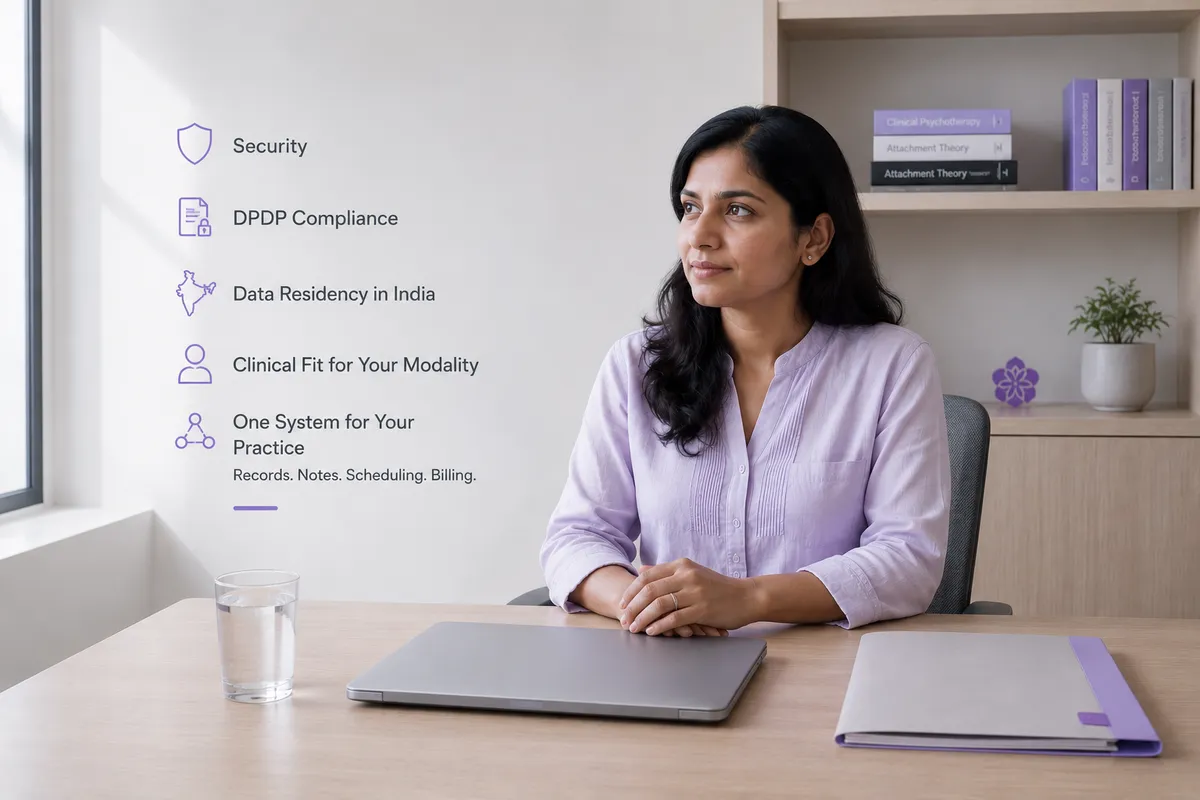
How to Choose Therapy Practice Software in India
A practical framework for choosing practice management software as a therapist in India: security, DPDP compliance, data residency, clinical fit, and the questions to ask before you commit.

How to Manage Therapy Clients Without Losing Track
Manage therapy clients without losing track: keep every client in one record, unify notes and scheduling, and protect client data. A practical guide for India.

How to Keep Client Data Safe as a Therapist in India
A practical guide to protecting client data in a therapy practice - the real risks, encryption, access control, secure storage, and what DPDP compliance requires day to day.