
How to Manage Therapy Clients Without Losing Track
Manage therapy clients without losing track: keep every client in one record, unify notes and scheduling, and protect client data. A practical guide for India.

Why client information gets scattered, what a unified system looks like, and a practical way to keep every client in one place.
Summary
Managing therapy clients without losing track comes down to one principle: keep everything about a client in one place. Most practitioners lose track because a client’s information is split across a calendar app, a notes file, a messaging thread, and a spreadsheet, none of which were built to hold clinical records or talk to each other. This article shows therapists, psychologists, and psychiatrists in India how to fix that, by moving to a single client record that holds notes, appointments, evaluations, and history together, organised so a client’s full story is always in one place. It covers what gets scattered across disconnected tools, what a unified client system looks like, how to organise the record, how to protect client data as you do it, and how to manage a caseload as a practice grows. The result is a practice where no client falls through the gaps, whether you see eight clients a week or run a clinic with several practitioners.
Table of Contents
- How to Manage Therapy Clients Without Losing Track
- What Gets Scattered When Your Tools Don’t Talk to Each Other
- What a Unified Client System Looks Like
- Organising the Client Record
- Keeping Client Data Safe as You Organise It
- Managing a Caseload as the Practice Grows
- A System You Can Put in Place
Managing therapy clients without losing track comes down to one principle: keep everything about a client in one place. The notes, the appointments, the evaluations, and the history belong in a single record, so that opening a client shows you the whole relationship rather than one fragment of it. Practitioners lose track when that information is split across separate tools that were never built to hold it together.
The scattering happens quietly. A calendar app for booking. A notes document for sessions. A messaging app for reminders. A spreadsheet for payments. Each was adopted because it was convenient at the time, and together they turn one client into five disconnected fragments.
This post lays out a practical way to close those gaps: what gets scattered and why it matters, what a unified client system looks like, how to organise the record, and how to keep client data safe while you do it. The aim is a practice where every client stays whole.
How to Manage Therapy Clients Without Losing Track
The short answer is to stop managing clients across tools and start managing them in one record. Everything a practice needs to track about a client belongs in a single place: who they are, when you see them, what happened in each session, how their care has changed, and where their history sits.
Five habits keep clients from slipping through the gaps.
-
Keep one record per client, so notes, appointments, and history live together rather than in separate apps.
-
Connect scheduling to the record, so every appointment is tied to the client it belongs to and nothing is booked in isolation.
-
Write documentation into the record, not into a separate file, so a session note is always where the next session expects it.
-
Hold the full history in one place, so returning to a client after weeks means opening the record, not reconstructing it from memory.
-
Protect the whole record under one set of security controls, so organising a client’s information does not spread it across accounts that were never built to keep it safe.
The sections below take each of these from principle to practice.
What Gets Scattered When Your Tools Don’t Talk to Each Other
A fragmented practice is the default outcome of good intentions. Each tool solves one problem well. None of them was built to hold a clinical relationship, and none of them shares what it knows with the others.
Here is what typically ends up scattered:
-
Appointments: sitting in a calendar app that knows the time but nothing about the client’s history or notes.
-
Session notes: in a document, a notebook, or a notes app, separated from the appointment they belong to.
-
Client history: spread across months of files with no single view of how care has progressed.
-
Communication: reminders and messages in a personal messaging app, mixed in with everything else on the phone.
-
Payments: in a spreadsheet that no other tool can see.
Part of the cost is the time spent moving between tools and reconciling what each one knows. The larger cost is the risk that something falls through a gap: a session that was never documented, a client whose history you cannot reconstruct before a session, an appointment a reminder never went out for. And because these tools were built for general use, client information ends up in accounts that were never designed to hold sensitive clinical data, which is a security and compliance exposure on top of an organisational one.
What a Unified Client System Looks Like
A unified system replaces the stack of disconnected tools with one place built for the whole client relationship. Instead of a calendar that does not know your notes and notes that do not know your calendar, everything about a client sits in a single record.
In practice, that means a client’s notes, appointments, evaluations, and history tie to one record. Booking an appointment connects it to the client. Writing a note files it in the same place. Reviewing a client before a session means opening one record and seeing the whole picture, from the first session to the most recent, rather than opening four apps and assembling it yourself.
This is the difference between a practice that runs on a foundation and one that runs on a patchwork. The foundation holds the client whole. The patchwork holds fragments and leaves the work of joining them to you, every time. For a fuller look at why one system beats a stack of tools, and how to evaluate one, see our guide on how to choose practice management software as a therapist in India.
Organising the Client Record
A single record only helps if what is inside it is organised. The goal is that anyone opening a client, including you before a session, can see the whole relationship at a glance.
A well-organised client record holds a few things clearly. It holds the client’s identifying information and the practical details of their care. It holds session notes in a form that fits the clinical work, so a psychiatrist’s structured evaluation and a counsellor’s process note each sit in the right structure rather than one generic box. It holds the appointments tied to the client, past and upcoming. And it holds the longitudinal history that carries the client’s story across every session, so the arc of care is visible rather than buried in a pile of separate files.
For psychiatric practice, this organisation matters more. A medication history that stretches across many reviews, a series of mental status examinations, and a diagnosis that has been revisited over time need structure to stay usable. Documentation shaped to the modality keeps that depth legible instead of flattening it. Keeping working notes distinct from finalised records also keeps the record clean, so the version you rely on is never confused with a draft.
Keeping Client Data Safe as You Organise It
Organising client information and protecting it are the same task. The moment a client’s record is spread across a personal drive, a messaging app, and a spreadsheet, it is also spread across accounts with no clinical security controls, which is where most exposure in a practice begins.
Bringing the record into one place is the first step to securing it. From there, three protections matter most.
-
Encryption keeps client data unreadable to anyone without the keys, so a lost device or a compromised account gives up nothing usable.
-
Access control by role and by client means not everyone can open every record, and every access is logged, so a client’s information is seen only by the people whose role requires it.
-
Data residency in India places client records on servers under Indian law, so you always know where the data lives and who is accountable for it.
These are also the foundations of compliance under the Digital Personal Data Protection Act, which places specific obligations on the practitioner who holds client data. Organising clients into one secure record is how you meet those obligations by design rather than retrofitting them later. For the day-to-day practice of protecting client information, see our guide on how to keep client data safe as a therapist in India.
Managing a Caseload as the Practice Grows
A system that works for a solo practice seeing a handful of clients has to keep working when the practice grows. Losing track gets easier, not harder, as the number of clients and practitioners rises.
For a solo practitioner, one record per client is usually enough to stay organised. As a practice adds practitioners and becomes a clinic, coordination becomes the challenge. Several clinicians share a caseload, a front desk books across the team, and clients are referred from one practitioner to another. Without a system built for it, that coordination is where clients slip: a referral that loses its history in the handover, a record two people edit in different places, access that no one is controlling.
A system built for a growing practice handles this by keeping each client in one record while governing who can see it. Access assigned by role and by client means a scheduling coordinator does not open clinical notes and a clinician sees the records their role allows. Each client stays in one record however many people work in the practice, so the information does not scatter again as the team grows. For a closer look at holding the whole client record in one place, see our page on client and patient management.
A System You Can Put in Place
Keeping track of therapy clients does not require more discipline. It requires a system that does not depend on discipline to hold together. The practices in this post reduce to one move: put every client in a single record, and run the practice from there.
Aroha is built for exactly this. It unifies client records, notes, and appointments in one system, with documentation shaped to the modality you practise and a longitudinal history that holds across the length of care. Client data is encrypted, protected by role-based access, and hosted on servers in India, and the platform is built to be ready for the DPDP Act. The same one-record system works whether you practise on your own or alongside other clinicians, so the way you keep clients organised on day one is the way you keep them organised as the practice grows.
The tools a practice runs on decide whether clients stay whole or scatter into fragments. Aroha publishes practical guides like this one for mental health practitioners in India, written for the way practices here actually work. Follow the blog for the rest of the series.
The information in this post is provided for general awareness and is not legal advice. For guidance specific to your practice’s obligations, consult a qualified legal professional.
Related Articles
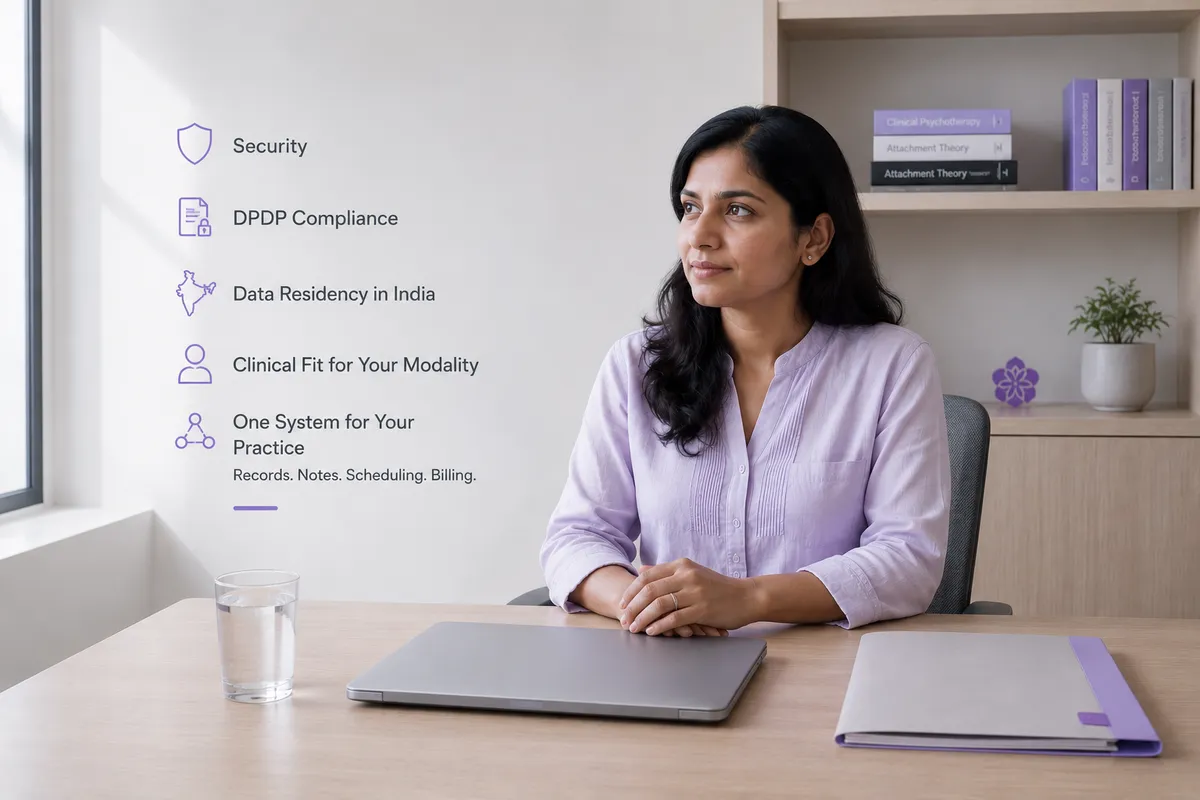
How to Choose Therapy Practice Software in India
A practical framework for choosing practice management software as a therapist in India: security, DPDP compliance, data residency, clinical fit, and the questions to ask before you commit.
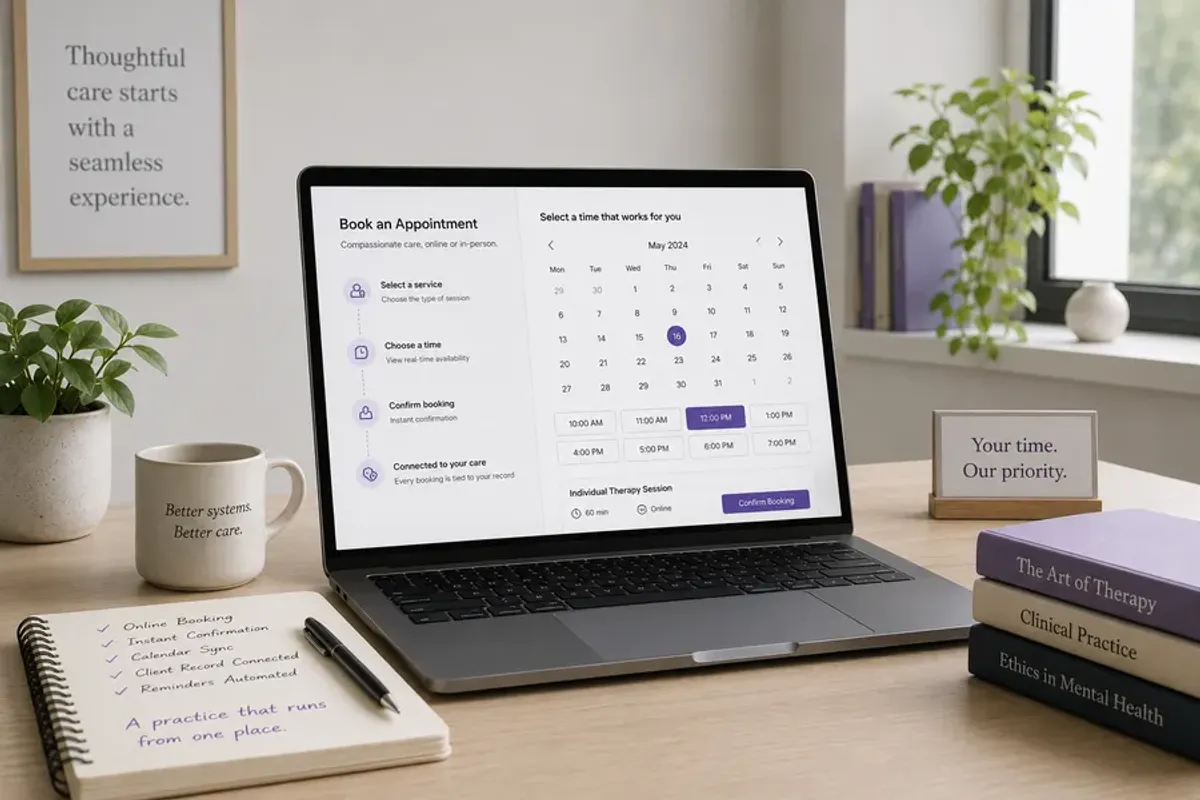
Set Up Online Booking for Your Therapy Practice
How to set up online booking for your therapy practice in India: what a booking system needs, how to tie bookings to the client record, and what to look for.

What to Look for in Mental Health Software Built for India
Mental health software built for India keeps client data on Indian servers, is DPDP-ready, and fits how care is practised here. What to look for, and how to tell.